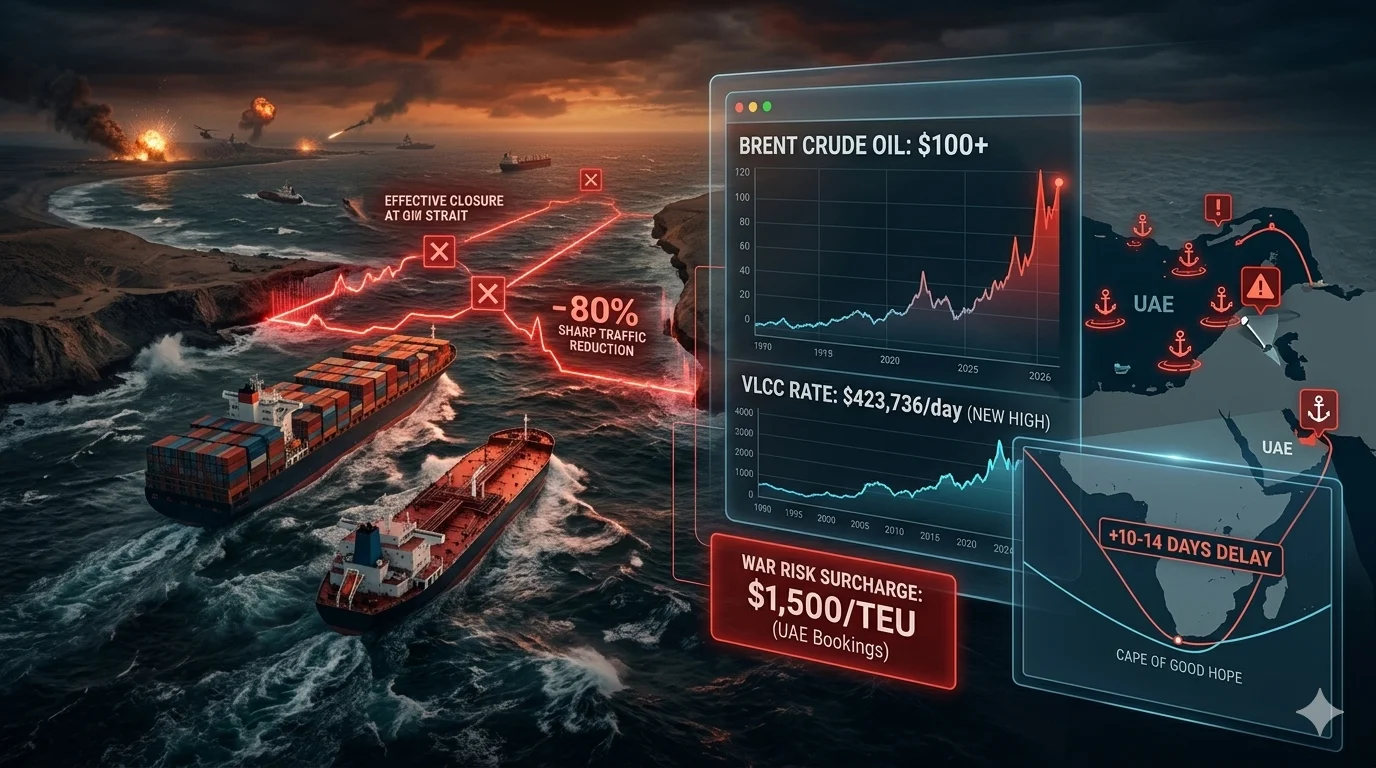
| The Strait of Hormuz crisis is the most significant disruption to UAE logistics since the COVID-19 pandemic. Oil has surpassed $100 per barrel for the first time since 2022. Maersk has suspended special cargo acceptance in and out of the UAE. Hapag-Lloyd is charging a War Risk Surcharge of $1,500 per TEU on all UAE bookings. VLCC tanker rates hit an all-time high of $423,736 per day. Traffic through the Strait is down 80%. Jebel Ali — the Middle East’s largest port — is directly affected. This article covers the confirmed facts, the freight rate impact, and the specific actions UAE logistics businesses must take right now. |
| WHAT HAS HAPPENED — CONFIRMED FACTS |
Strait of Hormuz Crisis — What We Know as of March 16, 2026
The US-Israel military conflict with Iran that began on February 28, 2026 has triggered the most significant disruption to global energy and shipping markets in a generation. Iran’s Islamic Revolutionary Guard Corps has effectively closed the Strait of Hormuz — the 21-mile-wide waterway through which approximately one-fifth of global oil supplies and 20% of global LNG normally transit. Shipping traffic through the strait is down 80% according to maritime intelligence firm Windward.
The direct impact on UAE logistics is severe. Maersk — widely regarded as a barometer of global trade — suspended special cargo acceptance in and out of the UAE on March 3, 2026, citing deteriorating security conditions. Hapag-Lloyd applied a War Risk Surcharge of $1,500 per TEU on all bookings to or from Iraq, Bahrain, Kuwait, Qatar, Oman, UAE, and Saudi Arabia, effective from all bookings issued on or after March 2, 2026. MSC and CMA CGM have issued fresh guidance seeking to prioritise safety amid the security situation.
Jebel Ali — the largest port in the Middle East and the UAE’s primary freight gateway — is directly affected. Ships that normally transit the Persian Gulf are rerouting through longer, costlier paths around the Cape of Good Hope. Some commercial vessels have anchored off the UAE coast while shipping companies assess security risks. Insurance premiums have reached levels that have led major marine war risk providers to withdraw cover for vessels operating in the Persian Gulf.
| $100+ Brent crude oil — March 2026 First time above $100 since 2022 — IRGC closure | $423,736 VLCC tanker rate per day All-time high — up 94% from previous week | 80% Traffic reduction — Strait of Hormuz Windward maritime intelligence — March 2026 |
| DIRECT UAE IMPACT |
How the Hormuz Crisis Is Affecting UAE Freight and Logistics Right Now
Jebel Ali Port — Current Status
Jebel Ali and Khor Fakkan — the UAE’s primary container ports — remain operationally open as of March 16, 2026. UAE ports have not officially closed. However, the practical impact is significant: major shipping lines have suspended or severely restricted cargo acceptance, insurance cover for vessels operating in the Gulf has been withdrawn by major providers, and vessels that do operate face dramatically higher war risk premiums passed through as surcharges to shippers.
For freight forwarders and importers using Jebel Ali, the immediate effect is that bookings are harder to secure, costs have increased significantly, and transit times for shipments rerouted around the Cape of Good Hope have extended by 10 to 14 days on Asia-origin cargo. The $1,500 per TEU war risk surcharge from Hapag-Lloyd applies to all existing bookings not yet loaded — not just new bookings.
Oil and Fuel Cost Impact on UAE Logistics
Oil above $100 per barrel has an immediate operational impact on every logistics business in the UAE. Diesel and bunker fuel costs are rising. Trucking and last-mile delivery costs are increasing as carriers apply fuel surcharges. For 3PLs and transport companies with large fleets, the cost impact is compounding weekly. Goldman Sachs has modelled scenarios ranging from Brent averaging $98 through April to an extreme case of $140 per barrel — the latter characterised by Oxford Economics as a potential ‘breaking point’ for the global economy.
Qatar LNG Halt — UAE Energy and Cold Chain Impact
Qatar’s state-owned energy firm QatarEnergy halted production of LNG at its two main facilities following military attacks on Ras Laffan and Mesaieed Industrial City. European natural gas futures jumped 30% following this announcement. For UAE cold chain and refrigerated logistics operations dependent on LNG-powered reefer containers, the combination of LNG supply disruption and higher operating costs is creating immediate pressure on temperature-controlled freight rates.
| UAE Logistics Segment | Immediate Impact | Severity | Action Required |
| Ocean Freight Forwarders | Maersk cargo suspension, $1,500/TEU WRS, Cape rerouting | Critical | Contact all clients immediately — advise delays and surcharges |
| Air Freight | DXB remains open — demand surge as ocean alternatives sought | High | Quote air alternatives for time-sensitive ocean cargo |
| 3PL and Warehousing | Inbound cargo delays — inventory planning disrupted | High | Advise clients of 10-14 day additional transit — adjust reorder points |
| Road Transport / Trucking | Diesel surcharges applying — fuel costs rising | Medium-High | Review fuel surcharge clauses in contracts — apply surcharges now |
| Cold Chain / Reefer | LNG halt affecting reefer container costs | High | Assess LNG fuel alternatives — review temperature-controlled contracts |
| Customs Brokers | Shipment delays creating documentation backlogs | Medium | Proactively extend dwell time estimates for affected clients |
| WHAT UAE LOGISTICS BUSINESSES MUST DO TODAY |
6 Immediate Actions for UAE Freight and Logistics Companies
Action 1: Contact All Active Clients With Affected Shipments Today
Every UAE freight forwarder with active ocean shipments must contact clients today. Do not wait for clients to ask. Explain the Maersk cargo suspension, the Hapag-Lloyd War Risk Surcharge, and the extended transit times resulting from Cape of Good Hope rerouting. Clients who receive proactive communication from their freight partner trust that partner more, not less. The forwarders who go silent during crises lose clients. The ones who communicate clearly retain them and gain referrals.
Action 2: Review All Open Bookings for WRS Exposure
The Hapag-Lloyd War Risk Surcharge of $1,500 per TEU applies to all bookings issued from March 2, 2026 onwards, all existing bookings not yet shipped, and cargo already on the water but not yet discharged. Review every open booking immediately. Identify which shipments are exposed to this surcharge. Communicate the additional cost to clients before it appears on their invoice — not after.
Action 3: Quote Air Freight Alternatives for Time-Sensitive Cargo
Dubai International Airport remains operational and unaffected by the Hormuz closure. For clients with time-sensitive cargo that would normally move by ocean through the Gulf, air freight is now the practical alternative. DXB has capacity available — the surge in demand has not yet fully materialised at the airport as of March 16. Freight forwarders who proactively offer air alternatives this week capture clients before competitors do.
Action 4: Publish Crisis Content for Your Ideal Clients
UAE shippers, importers, and manufacturers are searching Google right now for guidance on the Hormuz crisis and its impact on their supply chains. The freight forwarder or 3PL whose website publishes accurate, current guidance on what the crisis means for their specific cargo type and trade lane is the one getting the calls. Publish a client advisory on your website today — explain what the crisis means for your specialty lanes, what you are doing about it, and what options your clients have.
Action 5: Apply Fuel Surcharges to Road Transport Contracts
UAE trucking and transport companies with fuel surcharge clauses in their contracts should apply them now. Oil above $100 per barrel translates directly to diesel cost increases. Companies without fuel surcharge clauses should initiate conversations with contracted clients about temporary adjustments — the market conditions support the request and most clients will understand given the publicly visible crisis.
Action 6: Build Content That Captures Crisis Search Traffic
The search terms being used by UAE logistics buyers right now — ‘Jebel Ali port update,’ ‘UAE freight forwarder Hormuz crisis,’ ‘shipping disruption UAE March 2026’ — have almost no dedicated content pages competing for them. Logistics companies that publish specific, accurate content for these searches today will rank on Google within 24 to 48 hours and receive organic inquiries from businesses actively seeking guidance and new freight partnerships.
| UAE logistics companies that communicate clearly during this crisis and publish guidance content for affected shippers will gain more new client relationships in the next four weeks than in the previous six months. Rankpy builds the content that ranks UAE logistics companies for the specific searches their clients are making right now. Free audit at rankpy.com. |
| OUTLOOK — WHAT COMES NEXT |
Strait of Hormuz — Scenarios and Freight Implications
| Scenario | Probability | Oil Price | Freight Rate Impact | Duration |
| Diplomatic resolution — strait reopens | Low — March 16 | Returns toward $70-80 | WRS removed — rates normalise in 4-6 weeks | 2-4 weeks |
| Partial reopening with US Navy escorts | Medium | Stabilises $90-100 | Elevated WRS continues — slow normalisation | 4-8 weeks |
| Sustained closure — no resolution | High current trajectory | $110-140 range | Permanent Cape rerouting — structural rate increase | Months |
| Extreme escalation — $150-200 oil | Low but non-zero | $150-200 per barrel | Recession-level freight demand destruction | Unknown |
Goldman Sachs raised its 2026 US recession probability by 5 percentage points to 25% following the crisis. Oxford Economics models that oil averaging $140 per barrel for two months would be sufficient to push the eurozone, UK, and Japan into economic contraction. For UAE logistics companies, the practical planning horizon is 4 to 8 weeks of elevated disruption with the Sustained Closure scenario currently the most likely based on Iran’s stated position as of March 16, 2026.
FAQ
FAQs about Transport & Fleet SEO
Looking to learn more about SEO solutions for your business? Browse our FAQs:
Jebel Ali port remains operationally open as of March 16, 2026. However, major shipping lines including Maersk have suspended special cargo acceptance in and out of the UAE, Hapag-Lloyd is applying a War Risk Surcharge of $1,500 per TEU on all UAE bookings, and insurance cover for vessels in the Persian Gulf has been withdrawn by major providers. The port is open but significantly constrained in terms of vessel availability and booking accessibility. |
The Strait of Hormuz crisis has increased UAE freight rates through three mechanisms: War Risk Surcharges of $1,500 per TEU from Hapag-Lloyd and similar surcharges from other carriers, higher bunker fuel costs from oil above $100 per barrel, and extended transit times from Cape of Good Hope rerouting adding 10 to 14 days to Asia-origin voyages and corresponding vessel operating costs. Air freight rates from Dubai are also rising as demand shifts from disrupted ocean services. |
UAE freight forwarders should immediately review all open ocean bookings for War Risk Surcharge exposure, contact clients proactively to advise on delays and additional costs, offer air freight alternatives for time-sensitive cargo, publish crisis guidance content on their websites to capture the significant search demand from affected shippers, and apply applicable fuel surcharges to road transport contracts. Proactive communication during the crisis is the single most effective client retention action available. |
As of March 16, 2026, Iran’s IRGC has stated it will not allow any vessel linked to the US, Israel, or their allies through the Strait of Hormuz. Iran’s Supreme Leader has pledged to maintain the closure. The US has discussed but not yet implemented Navy escort operations. Goldman Sachs models the disruption lasting through at least April 2026 in their base case. A sustained closure scenario lasting several months is considered the most likely current trajectory by maritime analysts. |
UAE logistics companies get more clients during the Hormuz crisis by being visible on Google when affected shippers search for guidance and alternatives. Publishing accurate, current content about the crisis impact on specific trade lanes and cargo types, maintaining active Google Business Profile posts with crisis updates, and offering proactive communication about alternatives positions logistics companies as the credible, responsive partner shippers turn to. Rankpy helps UAE logistics companies build this content visibility — free audit at rankpy.com. |