An SEO agency for logistics companies is a specialist digital marketing partner that increases a logistics company’s organic search visibility for the specific keywords freight shippers, importers, and supply chain managers use when searching for services. The right agency understands logistics terminology, buyer intent in B2B freight markets, and the E-E-A-T signals Google applies to commercial logistics content. Most general SEO agencies do not. Choosing a generalist agency for logistics SEO produces slow results and wasted budget — because logistics buyer searches are industry-specific and require industry-specific content strategy to rank.
WHY LOGISTICS SEO IS A SPECIALIST JOB
Why a General SEO Agency Will Not Get Results for Your Logistics Company
Most SEO agencies are built around consumer brands, e-commerce, and SaaS companies. Their keyword research tools, their content frameworks, and their link-building playbooks are designed for industries where buyers search in simple, high-volume terms. ‘Best running shoes.’ ‘Cheap flights London.’ ‘CRM software for small business.’
Logistics buyers do not search this way. A supply chain manager evaluating a new 3PL provider searches ‘bonded warehouse Chicago with temperature control.’ A procurement officer sourcing a freight forwarder searches ‘ocean freight forwarder Midwest to Germany documentation support.’ An e-commerce operator looking for fulfillment help searches ‘pick and pack 3PL Los Angeles Shopify integration.’
A general SEO agency sees these as obscure long-tail searches with low volume. A logistics SEO specialist sees them as exactly what they are: buyer-intent searches from decision-makers with real freight and real budgets. The entire strategy — keyword selection, content structure, E-E-A-T signals, internal linking — is different when you understand who is searching and why.
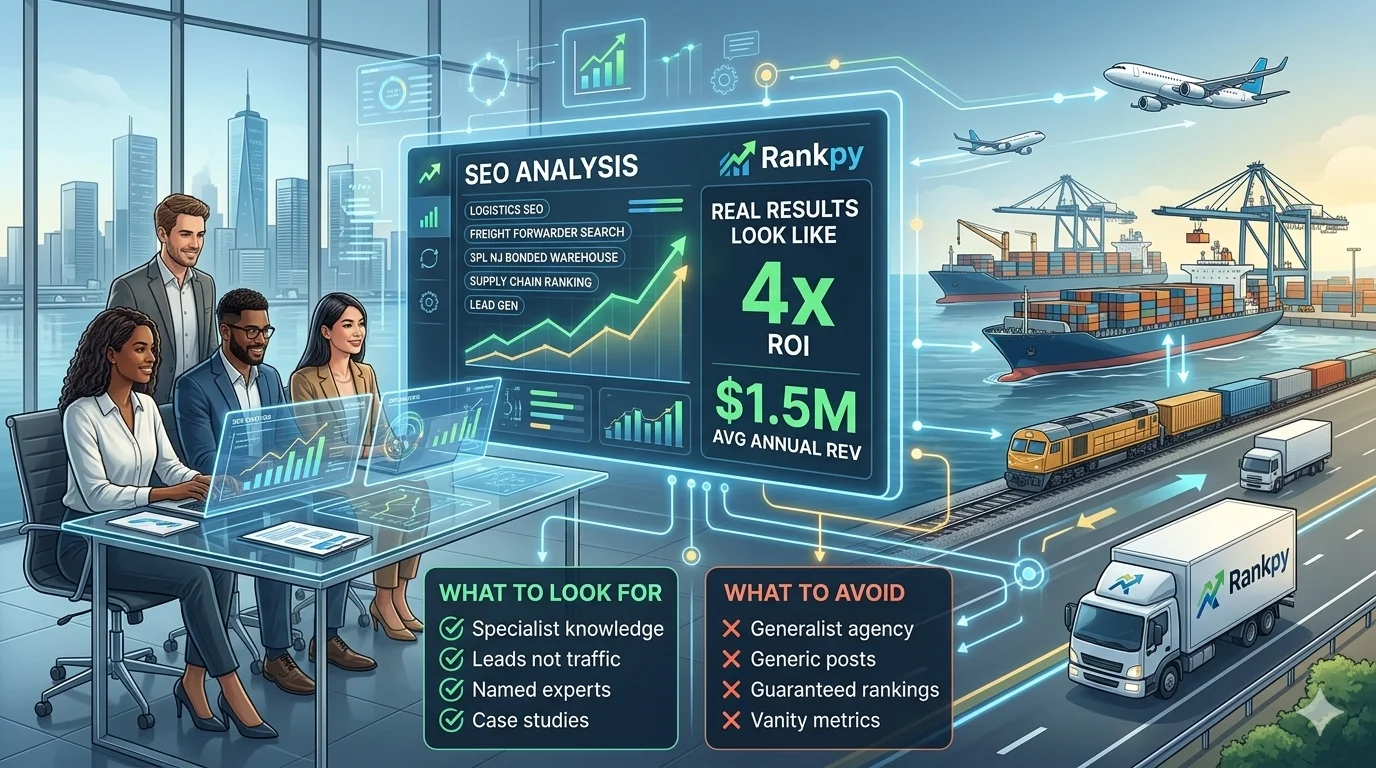
$1.5MAvg annual revenue from logistics SEO When done correctly — First Page Sage data 2024
60-90Days to first rankings For niche logistics keywords — specialist agency
4xHigher ROI vs paid ads Over 24 months for logistics organic vs PPC
WHAT A REAL LOGISTICS SEO AGENCY DOES
What Separates a Logistics SEO Specialist from a Generalist
Blog posts about ‘top 10 shipping tips’ — no buyer intent
Lane pages, commodity guides, compliance explainers targeting real searches
E-E-A-T building
Generic author bios, standard about page
Named logistics professionals, certifications listed, case studies with real metrics
Link building
Generic directory submissions, guest posts on marketing blogs
FreightWaves, Journal of Commerce, trade association directories, logistics partners
Technical audit
Standard speed and indexing check
Schema for logistics services, structured data for routes, local SEO for depots
Reporting
Traffic and rankings report
Leads generated, quote requests, conversion rate from organic traffic
HOW TO EVALUATE A LOGISTICS SEO AGENCY
6 Questions to Ask Before Hiring an SEO Agency for Your Logistics Business
1
Do You Have Active Clients in Logistics, Freight, or Transportation? Ask for two or three current or recent logistics clients and the results they produced. Not case studies from the agency website — ask for verifiable examples you can look up. A logistics SEO specialist will have ranking evidence you can check in Google yourself. A generalist will show you traffic graphs with no way to verify the quality of that traffic or whether it generated business.
2
Show Me the Actual Keywords You Would Target for My Business Ask for a sample keyword map in your first conversation. If the agency comes back with broad terms like ‘logistics services’ or ‘freight forwarding company,’ they are not a specialist. If they come back with route-specific, commodity-specific, and service-specific terms that your actual buyers search, they understand the market. This one question filters out eighty percent of agencies immediately.
3
How Do You Measure Success — Traffic or Leads? Traffic is a vanity metric for logistics companies. A thousand visits from people searching ‘what is a freight forwarder’ produces zero leads. An agency that measures success in keyword rankings for buyer-intent terms, quote requests, and contact form submissions from organic traffic is measuring the right things. Ask specifically: at month six, what does success look like in numbers that affect revenue?
4
What Is Your Content Production Process? Content is the core of logistics SEO. Ask who writes it, how industry accuracy is verified, and what process ensures the content reflects genuine logistics expertise rather than surface-level rewrites of existing articles. A specialist agency has either in-house logistics writers or a structured review process involving logistics professionals. A generalist has content writers who research the topic for the first time per article.
5
What Is Your Approach to E-E-A-T for Logistics Content? E-E-A-T (Experience, Expertise, Authoritativeness, Trustworthiness) is Google’s framework for evaluating content quality. For B2B logistics, Google applies this rigorously because incorrect logistics information can affect real commercial decisions. Ask how the agency builds E-E-A-T signals: named authors with verifiable credentials, case studies with specific metrics, external mentions in trade publications. If they cannot answer this question, they are not doing logistics SEO correctly.
6
What Does Your Reporting Look Like After Month Three? Request a sample report. It should show keyword position movement for the specific terms you are targeting, organic traffic segmented by landing page, conversion events from organic traffic, and a forward plan for the next 90 days. A report that only shows traffic growth without keyword specificity and lead attribution is concealing more than it reveals.
Want to Know Where Your Logistics Website Stands?
Rankpy runs a free SEO audit built specifically for logistics, freight, and transportation businesses. No automated report. No generic checklist. A real analysis of your rankings, technical issues, and content gaps by a team that works exclusively in this industry. Request yours at rankpy.com — takes 10 minutes, costs nothing.
RED FLAGS — AGENCIES TO AVOID
Warning Signs That an SEO Agency Is Wrong for Your Logistics Company
They guarantee page one rankings within 30 days. No ethical SEO agency guarantees rankings on any timeline because rankings are determined by Google, not by the agency. Any guarantee of rapid rankings typically signals low-quality tactics that produce short-term gains and long-term penalties.
They send a generic proposal without asking about your services, your lanes, or your target clients. A logistics SEO strategy that does not start with understanding your specific service mix and buyer profile is not a strategy — it is a template being sold to every client regardless of industry.
They do not ask for access to your Google Search Console or Google Analytics. An agency that cannot see your current search performance cannot build a strategy based on what is actually happening with your website. This is either incompetence or a sign they are planning to present generic activity rather than measurable results.
Their own website does not rank for the services they are selling you. Search ‘SEO agency for logistics companies.’ If the agency pitching you is not visible for their own target keywords, you have your answer about what they will do for yours.
FAQ
FAQs about Transport & Fleet SEO
Looking to learn more about SEO solutions for your business? Browse our FAQs:
An SEO agency for logistics companies increases a logistics company’s organic search visibility for the buyer-intent keywords that shippers, importers, and supply chain managers use when evaluating providers. This includes identifying specific lane, commodity, and service searches relevant to the company’s offering, fixing technical issues preventing the site from ranking, producing logistics-specific content that earns rankings, building authority signals through industry-relevant links and E-E-A-T signals, and tracking results in lead generation rather than just traffic volume.
Logistics SEO services range from $500 to $3,500 per month for small and mid-size logistics companies to $5,000 to $15,000 per month for larger operations with multiple service lines or geographic markets. The investment reflects content production volume, technical work required, and link-building effort. SEO for logistics delivers an average ROI of $1.5M in annual revenue when executed correctly — making it one of the highest-return marketing investments available to logistics companies with a multi-year perspective.
For specific, low-competition buyer-intent searches — particular lanes, commodity specialties, compliance services — a logistics website can achieve first-page Google rankings within 45 to 90 days when a specialist agency fixes technical issues and publishes well-structured content. Broader competitive terms take three to six months. The most important factor is working with an agency that targets achievable buyer-intent keywords rather than broad terms with overwhelming competition.
A general SEO agency applies frameworks built for e-commerce, SaaS, and consumer brands to logistics businesses — producing slow results because logistics buyer searches require industry-specific content strategy, terminology, and E-E-A-T signals. A logistics SEO specialist understands that logistics buyers search by lane, commodity, and compliance requirement, not by generic service terms. They produce content that answers real logistics buyer questions, build links from relevant industry sources, and measure success in qualified leads rather than traffic volume.
Yes. SEO is proportionally more accessible for small logistics companies than paid advertising because the investment is in content and technical work rather than ongoing ad spend. A small freight broker or 3PL investing $1,500 to $2,000 per month in focused logistics SEO for six months builds a content asset that generates inbound leads for years. The same budget in Google Ads buys approximately 50 to 100 clicks per month in competitive logistics markets and stops generating leads the day the budget pauses.