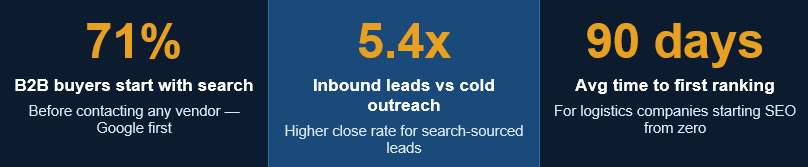
Logistics businesses get more clients through three channels that compound over time: organic search (SEO), referral systems, and strategic outbound targeting. Cold calling and random networking produce inconsistent results because they depend on timing and luck. A logistics company that ranks on Google for the exact service a shipper is searching for gets inbound inquiries from buyers who are already looking — no pitch required. This guide covers what actually works in 2025 for freight brokers, 3PLs, freight forwarders, and transportation companies.
THE REAL REASON YOUR PIPELINE IS INCONSISTENT
Why Most Logistics Companies Struggle to Find Clients Consistently
Here is the uncomfortable truth about business development in logistics: most companies are entirely dependent on referrals and relationships that were built years ago. When those relationships slow down — a key contact retires, a major client shifts to a competitor, the economy softens — there is nothing underneath to catch the fall.
The logistics companies that grow consistently in 2025 have one thing the others don’t: a system that generates inbound interest from people who are actively looking for what they offer. They show up when a shipper searches ‘freight forwarder Chicago’ or ‘cold chain 3PL Texas’ or ’48-state trucking carrier.’ The shipper finds them, reads their content, and calls. No pitch. No cold email. No waiting for a referral.
That system is organic search — and most logistics websites are invisible on it. Not because SEO is complicated, but because logistics companies consistently make the same five mistakes when they try to build an online presence.
WHAT ACTUALLY WORKS IN 2025
5 Client Acquisition Strategies That Work for Logistics Companies Right Now
1
Rank for the Specific Service Your Best Clients Search For Your best potential clients are not searching for ‘logistics company.’ They are searching for exactly what they need: ‘LTL freight broker Illinois,’ ‘pharmaceutical 3PL New Jersey,’ ‘flatbed carrier Texas to California,’ ‘customs broker Los Angeles port.’ These are buyer-intent searches — people with money, a shipment, and a deadline. A logistics company that ranks for three or four of these specific searches gets consistent inbound leads without any outbound effort. Start with the services you do best and build content around the exact language your clients use when they have a problem.
2
Build a Google Business Profile That Actually Converts If you serve clients within a specific city or region, your Google Business Profile is the highest-leverage free tool available to you. A fully optimized profile with services listed, photos of your facility or fleet, weekly posts, and a consistent flow of client reviews ranks in local map results for searches like ‘freight broker near me’ or ‘3PL warehouse Houston.’ Most logistics company GBP profiles are incomplete — no service descriptions, no posts, two photos, three reviews. Optimizing yours takes one afternoon and produces results for years.
3
Target Companies That Are Already Shipping — Not the Ones You Hope Will Ship The most efficient outbound strategy for logistics companies is not blasting cold emails to everyone in a bought list. It is identifying companies that are actively importing or exporting and reaching out with something specific. US import records are publicly available through services like ImportYeti and Panjiva. Search for companies importing product categories relevant to your specialty. You can see their shipment history, their current carriers, and their volume. An outreach message that references a company’s specific shipping patterns converts at five to ten times the rate of a generic ‘we offer logistics services’ email.
4
Turn Every Completed Shipment Into a Case Study Shippers evaluating logistics providers want evidence, not promises. A one-page case study — ‘how we moved 40 refrigerated loads from Miami to Chicago during a carrier capacity crunch and delivered 98% on time’ — does more selling than any brochure. Publish these on your website with specific numbers: weight, lanes, timeline, challenge solved. These pages rank for long-tail search terms, build credibility with prospects reading your site, and give your sales team something concrete to send after a first conversation.
5
Be the Most Useful Resource in Your Niche — Then Let That Do the Selling The logistics companies that dominate search results in 2025 are not the ones with the flashiest websites. They are the ones that have answered, in writing, every question their ideal client asks before picking up the phone. What does LTL freight cost? How does customs clearance work? What is the difference between a freight broker and a carrier? When a shipper Googles these questions and your website provides the clearest, most useful answer, you earn their trust before they have ever spoken to you. By the time they call, the sale is mostly done.
Want to know exactly why your logistics website isn’t ranking? Rankpy runs a free 10-minute SEO audit specifically for logistics, freight, and transportation companies. No templates, no generic advice — just a clear picture of what’s holding your site back. Request yours at rankpy.
WHAT NOT TO DO
3 Client Acquisition Approaches That Waste Time in Logistics
Trade show attendance without follow-up. Most logistics companies spend $8,000 to $20,000 attending industry events and collect business cards that never convert because there is no structured follow-up system. If you attend shows, build a 30-day email sequence that activates the day after the event — otherwise you are paying for conversations that go nowhere.
Generic social media posting. Posting ‘Happy Friday!’ and stock photos of trucks on LinkedIn does not generate logistics clients. What does generate clients on LinkedIn is publishing specific expertise — a post about why spot rates are moving in a particular lane, a breakdown of how to read a Bill of Lading, a short analysis of what a port strike means for importers. Content that demonstrates you know things other people don’t builds the audience that eventually becomes clients.
Waiting for the website to ‘work.’ A logistics website that was built five years ago, has not been updated since, and has no blog or content section is not a client acquisition tool. It is a digital business card. The companies consistently winning new clients online treat their website as an active sales asset that gets updated, expanded, and optimized continuously.