| Trucking company SEO services increase organic search visibility for trucking carriers so shippers find them when searching for capacity in specific lanes, freight types, and service areas. The US trucking industry is a $900 billion market with over 500,000 registered carriers. Most of them have nearly identical websites and are invisible in organic search. The carriers winning inbound shipper calls in 2025 rank for specific lane and commodity searches that shippers use when they need capacity — not generic terms like ‘trucking company.’ |
| THE US TRUCKING INDUSTRY’S DIGITAL MARKETING PROBLEM |
Why 90% of US Trucking Companies Are Invisible Online — And Who Is Winning
There are over 500,000 registered motor carriers in the United States. Visit the websites of a hundred of them at random and you will find near-identical content: a homepage with a truck image, a services page listing ‘dry van, flatbed, refrigerated,’ an about page with a company history, and a contact form. Almost none of them rank for anything a shipper would search when they need a carrier.
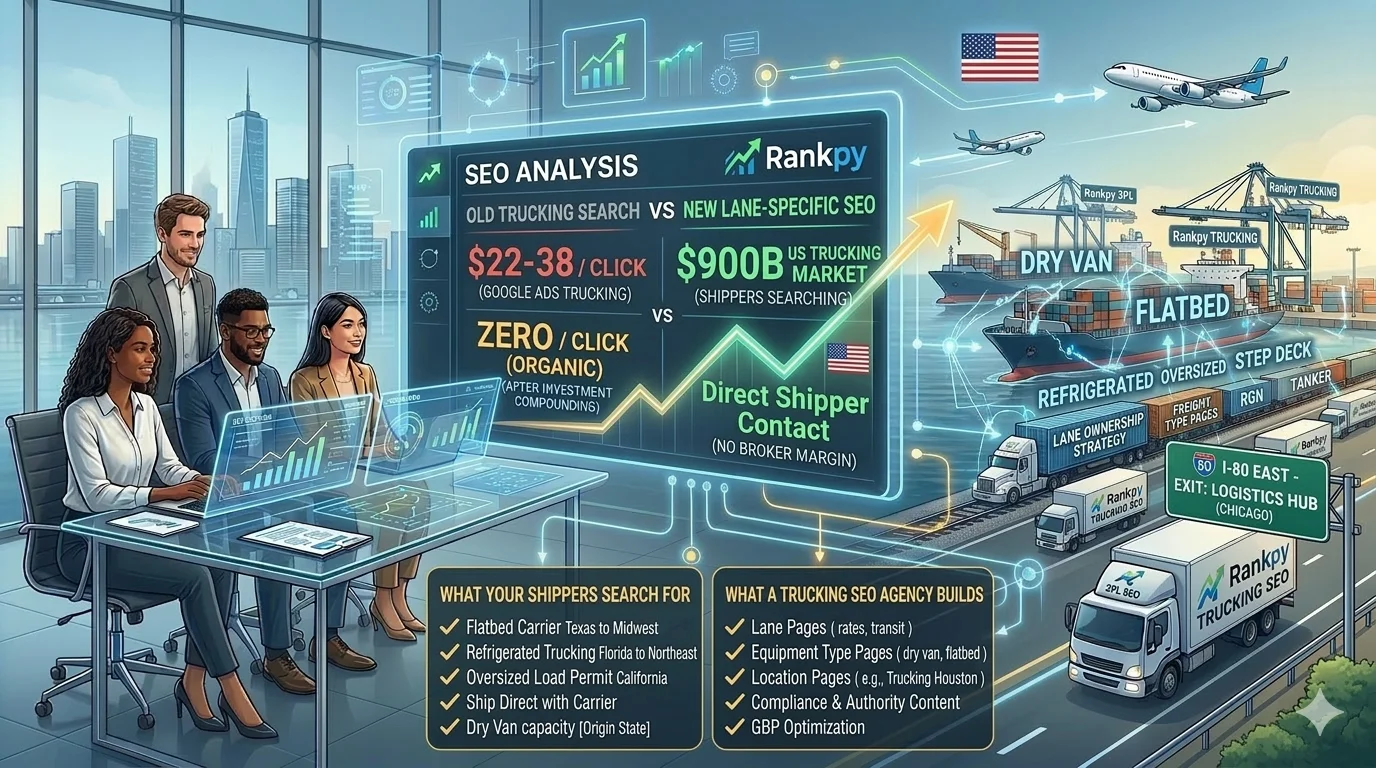
The trucking companies that are winning inbound shipper business from organic search in 2025 have done one thing differently: they have published specific content targeting the searches that shippers with active loads make. ‘Flatbed carrier Texas to Midwest.’ ‘Refrigerated trucking Florida to Northeast.’ ‘Oversized load permit hauling California.’ These are not high-volume search terms — but the person searching them has a specific load, a specific lane, and a specific deadline. They are ready to book.
A trucking company that ranks for three or four of these searches receives qualified inbound shipper contacts every week from buyers who found them through Google. No broker involved. No load board fees. Direct shipper contact. This is why SEO has become the highest-ROI marketing investment for trucking companies that understand how it works.
| 500K+ Registered US motor carriers Nearly all invisible in organic search | $900B US trucking market 2024 Shippers searching for carriers online every day | Direct Shipper contact from organic No broker margin — direct relationship |
| WHAT TRUCKING SEO INCLUDES |
Trucking Company SEO Services — What Each Element Does
| SEO Component | What It Does | Trucking-Specific Application | Expected Result |
| Lane page creation | Dedicated page per primary lane with rates, transit times, capacity | ‘Flatbed trucking Texas to Midwest’, ‘Reefer carrier Southeast to Northeast’ | Page one for lane-specific searches in 60-90 days |
| Freight type pages | Pages per equipment type targeting commodity searches | Dry van, flatbed, reefer, step deck, RGN — each as dedicated page | Multiple ranking positions for equipment searches |
| Location pages | City and region pages for local shipper searches | ‘Trucking company Houston’, ‘carrier Chicago to Denver’ | Local map pack and organic rankings |
| Load board alternative content | Content targeting shippers trying to avoid broker margins | ‘Ship direct with carrier’, ‘avoid freight broker fees’ | Captures direct shipper intent searches |
| Compliance and authority content | FMCSA, Hours of Service, ELD guides for shippers | Builds E-E-A-T and ranks for regulatory searches shippers make | Authority building — accelerates all rankings |
| GBP optimization | Local map visibility for city-specific carrier searches | Complete GBP with equipment types, service area, regular posts | Map pack rankings for local shipper searches |
| THE LANE OWNERSHIP STRATEGY |
How Smart Trucking Companies Own Specific Lanes in Google Search
Lane ownership in SEO means building the most thorough, most useful content for a specific origin-destination pair and dominating the search results for that lane. A refrigerated carrier that primarily runs loads between Florida and the Northeast can own the search results for ‘reefer carrier Florida to New York,’ ‘refrigerated trucking Miami to Boston,’ and ‘temperature controlled freight Southeast to Northeast.’
These are not abstract rankings. A shipper in Florida with a load of produce going to New York who searches this term and finds your page — with transit times, your carrier safety rating, your equipment list, and a contact form — calls you. Not a broker. Not a load board. You. At full carrier rate.
The same strategy works for flatbed, oversized, tanker, lowboy, and specialized freight. Every equipment type, every primary lane, every specialty commodity is a content opportunity. The trucking company that publishes this content first and most thoroughly owns those search positions for years.
| 1 | Map Your Five Most Profitable Lanes Start with the five lanes where you have the strongest carrier network, the best transit performance, and the highest margin. These are your content priorities. One page per lane, each targeting the specific searches shippers in those markets make. Publish these five pages in month one. |
| 2 | Create One Page Per Equipment Type Dry van, flatbed, reefer, step deck, lowboy, tanker — each equipment type is a separate buyer search. A shipper who needs flatbed is not searching ‘trucking company.’ They are searching ‘flatbed carrier [origin state]’ or ‘flatbed freight [commodity].’ Equipment type pages target these buyers directly. |
| 3 | Add Shipper Value Content — Not Just Service Descriptions The trucking company websites that convert best include content that helps shippers do their job better: how to prepare freight for flatbed shipment, what documents are required for cross-border trucking, how to read a rate confirmation, what FMCSA safety rating means. This content builds trust, earns time on site, and positions your company as the carrier that knows what it is doing. |
| Want to Know Where Your Logistics Website Stands? |
| Rankpy runs a free SEO audit built specifically for logistics, freight, and transportation businesses. No automated report. No generic checklist. A real analysis of your rankings, technical issues, and content gaps by a team that works exclusively in this industry. Request yours at rankpy.com — takes 10 minutes, costs nothing. |
FAQ
FAQs about Trucking Company SEO Services
Looking to learn more about SEO solutions for your business? Browse our FAQs:
Trucking company SEO services are search engine optimization programs specifically designed for motor carriers to increase organic visibility for the searches shippers make when looking for trucking capacity. This includes lane-specific page creation, equipment type pages, location pages, Google Business Profile optimization, and compliance content that builds E-E-A-T authority. The goal is inbound shipper contacts from Google — direct relationship with no broker margin or load board fee. |
Trucking companies get more shippers through SEO by ranking for the lane-specific, equipment-specific, and service-area searches that shippers make when they need capacity. A reefer carrier that ranks for ‘refrigerated trucking Florida to Northeast’ receives shipper calls from buyers with active loads in that exact lane. Building this visibility requires dedicated content for each primary lane and equipment type, Google Business Profile optimization for local searches, and consistent content publishing that builds topical authority. |
Trucking companies typically see first rankings for lane-specific and equipment-type searches within 45 to 90 days of publishing well-structured content. Location-based searches with Google Business Profile optimization show movement within 30 to 60 days. The speed of results depends on competition in the target lanes and markets — regional lanes in mid-size markets rank faster than major national corridors. Consistent monthly content publication produces compounding results with each new lane or equipment page added. |
SEO is particularly valuable for small trucking companies because it creates direct shipper relationships without broker intermediaries or load board fees. A small carrier with five to ten trucks generating three to five direct shipper contacts per month from organic search — each representing a load at full carrier rate without broker commission — adds meaningful revenue with no ongoing ad spend. The investment in content pays indefinitely, unlike load board subscriptions or ad budgets that stop producing results when paused. |
Trucking companies should target three keyword categories: lane-specific (refrigerated trucking [state] to [state], flatbed carrier [origin city]), equipment-specific (step deck trucking, RGN lowboy transport, tanker carrier), and local (trucking company [city], carrier [city]). Avoid competing for broad terms like ‘trucking company’ or ‘freight carrier’ dominated by aggregators and large carriers. Each specific lane and equipment type page competes in a much less crowded field and reaches buyers who are further along in their search — with an active load and a real deadline. |