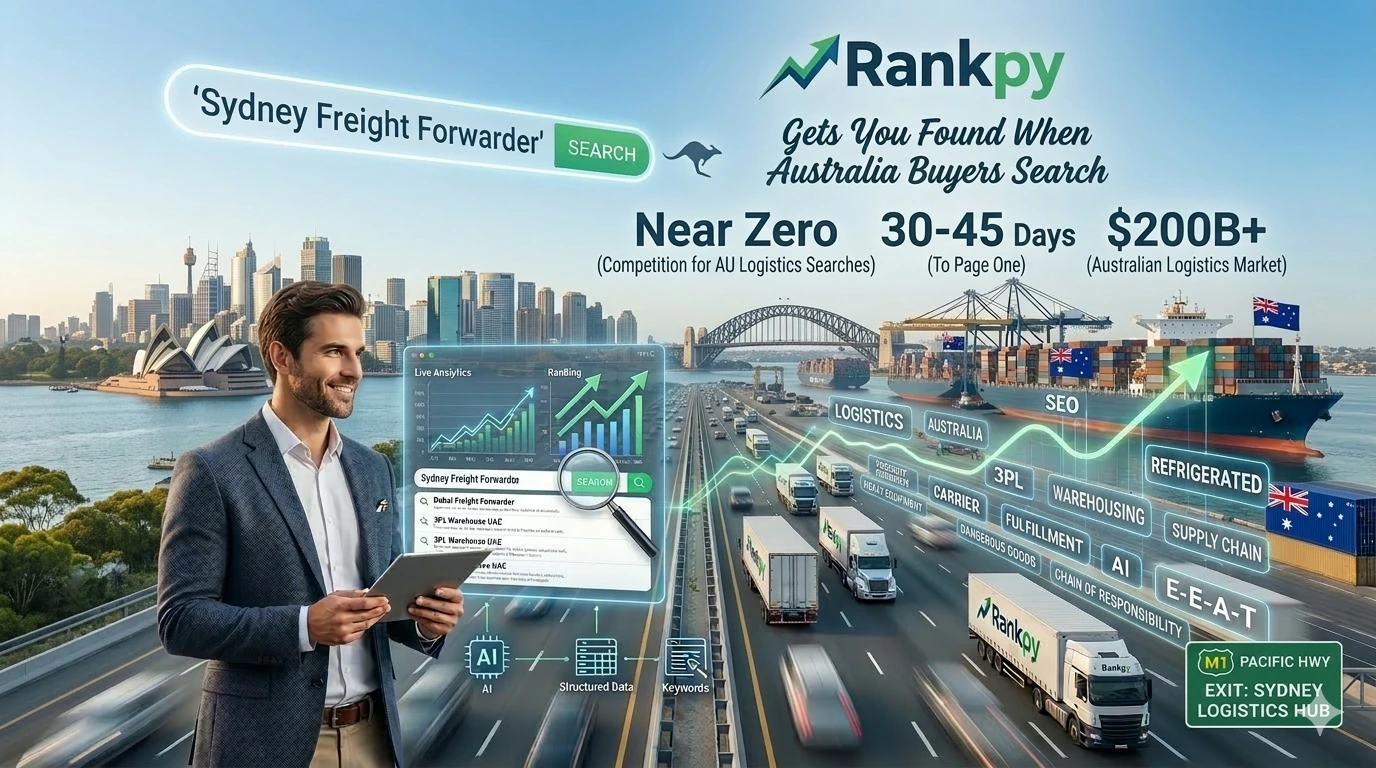
SEO for customs brokers means optimizing your website so importers, exporters, and freight companies find you on Google when they search for customs clearance help. The most effective approach combines port-specific landing pages, compliance content targeting tariff and documentation searches, and Google Business Profile optimization. Customs brokers who publish content around their specific ports, commodity specialties, and compliance expertise rank within 60 to 90 days for buyer-intent searches that generate consistent client inquiries.
WHY CUSTOMS BROKERS NEED SEO
The Problem: Importers Search Google First — Most Customs Brokers Are Invisible
Every day, importers and exporters search Google with urgent, specific questions. ‘Customs broker Los Angeles port.’ ‘ISF filing service USA.’ ‘Customs clearance Felixstowe UK.’ ‘Section 301 tariff classification help.’ These are not casual searches — they come from business owners with active shipments, real deadlines, and immediate budget to hire.
The customs brokers who appear in these searches get the call. The ones who do not — no matter how experienced they are — remain dependent on referrals, freight forwarder relationships, and cold outreach. The difference between these two groups is almost never expertise. It is almost always content.
Most customs broker websites follow the same template: a homepage explaining what a customs broker does, a services page listing their capabilities, and a contact form. None of this ranks for anything a buyer would search. A shipper who needs ISF filing does not search ‘what is a customs broker.’ They search ‘ISF filing service’ and the name of their port. The broker whose website answers that specific question gets the inquiry.
720/mo‘SEO for customs brokers’ searches Plus thousands of port and compliance searches monthly
Low KDCompetition for specific customs searches Port-specific terms are almost uncontested
60-90Days to rank for buyer-intent customs searches When correct content strategy is applied
THE KEYWORD STRATEGY
What Importers Actually Search — The Customs Broker Keyword Map
Customs broker SEO works when you stop targeting what you think people search and start targeting what they actually type. There are four distinct search categories that produce customs broker inquiries from Google.
Category 1: Port-Specific Searches
These are the highest buyer-intent searches in customs brokerage. An importer searching ‘customs broker Los Angeles’ or ‘customs clearance Felixstowe’ has an active shipment and needs help now. Every major port you work with needs a dedicated page on your website.
Port / Region
Primary Search
Monthly Volume
Competition
Los Angeles / Long Beach
customs broker Los Angeles
2,400
Medium
New York / New Jersey
customs broker New York
1,900
Medium
Miami
customs broker Miami
1,100
Low-Medium
Houston
customs broker Houston
880
Low
Chicago
customs broker Chicago
720
Low
Seattle / Tacoma
customs broker Seattle
590
Very Low
Felixstowe (UK)
customs clearance Felixstowe
480
Very Low
Jebel Ali (UAE)
customs broker Jebel Ali
390
Very Low
Sydney (AU)
customs broker Sydney
520
Low
Category 2: Service-Specific Searches
These target importers who know exactly what they need. ISF filing, AMS filing, entry preparation, tariff classification — each of these deserves a dedicated page with specific, accurate information about the process.
Service Search
Volume
Intent
ISF filing service
1,300/mo
High — active shipment
customs bond service
980/mo
High — importer setting up
tariff classification service
720/mo
High — compliance need
AMS filing service
590/mo
High — active shipment
importer of record service
880/mo
High — market entry
customs clearance service
2,100/mo
High — active shipment
Section 301 tariff help
540/mo
High — tariff concern
duty drawback service
480/mo
High — cost recovery
Category 3: Commodity-Specific Searches
Importers search by what they are importing. A food importer searches ‘customs broker for food imports.’ A medical device company searches ‘FDA customs clearance medical devices.’ These searches have lower volume but extremely high conversion rates — the searcher is a buyer with a specific, recurring need.
Category 4: Compliance and Documentation Searches
Post-Brexit in the UK, Section 301 tariffs in the US, CBAM in the EU — compliance searches have exploded in volume and almost no customs broker website has content targeting them. These searches come from importers who are worried about getting something wrong and willing to pay for expert guidance.
THE CONTENT STRATEGY
What Content a Customs Broker Website Needs to Rank and Convert
1
Port Landing Pages — One Per Port You Work With Create a dedicated page for every port or airport you service. The page should explain your specific capabilities at that port, your relationships with CBP or HMRC, your turnaround times, and the commodity types you commonly clear there. Include the exact search term in the H1, URL, and first paragraph. A customs broker with dedicated pages for five ports ranks for five different sets of buyer-intent searches.
2
Service Pages With Real Process Detail Your ISF filing page should explain exactly how ISF works, what information you need from the importer, what the penalties for late filing are, and why using a licensed broker reduces risk. This is the content that ranks and converts — because it demonstrates competence before the buyer calls you. Thin pages that just say ‘we offer ISF filing’ rank for nothing.
3
Compliance Guides Targeting Regulatory Searches Write guides on Section 301 tariffs, first sale valuation, bonded warehouse options, free trade agreements your clients can use. These attract importers at the research stage — before they have selected a broker — and position you as the credible expert they call when they are ready to commit.
4
Google Business Profile Optimization For local customs broker searches, Google Maps results appear above organic rankings. A fully optimized GBP with your port listed as your service area, weekly posts about customs updates, and a consistent review strategy captures buyers who find you on the map before they even reach the organic results.
5
FAQ Schema on Every Page Google AI Overview and Gemini pull answers from pages with structured FAQ schema. Every customs broker page should have five to seven FAQ entries covering the most common questions about that service or port — formatted with Rank Math FAQ schema so AI tools can cite your content when importers ask for customs guidance.
RESULTS TIMELINE
What Customs Brokers Achieve With a Proper SEO Strategy
Month
What Happens
What You See
Month 1
Technical fixes, port pages built, GBP optimized
Impressions start appearing in Search Console for target keywords
Month 2
Service pages published, compliance guides launched
First page 2-3 rankings for low-competition port searches
Month 3
FAQ schema live, internal linking complete
First page 1 rankings — port-specific searches converting
Month 4-6
Authority building, new commodity pages
5-15 qualified importer inquiries per month from organic
The customs brokerage industry runs almost entirely on relationships and referrals. That is exactly why SEO is such a powerful advantage — because your competitors have not invested in it. The first customs broker in your port market to publish specific, accurate content for importer searches will dominate those searches for years.
COMMON MISTAKES
Why Most Customs Broker SEO Fails
Targeting ‘customs broker’ nationally instead of port-specific searches. A mid-size customs broker cannot compete with TradeIX, Flexport, or C.H. Robinson for generic national terms. They can absolutely compete for ‘customs broker Houston’ or ‘ISF filing service Miami’ — and those searches convert better anyway because they come from buyers in your actual service area.
Publishing one thin services page instead of individual pages per service. Google cannot rank a single page for fifteen different services. Each service needs its own dedicated page with substantive, accurate content. A customs broker with twelve service pages has twelve chances to rank — one with a single services page has one.
Ignoring compliance content because it feels too technical. The importer who searches ‘how does Section 301 exclusion work’ and finds a clear, accurate answer on your website is far more likely to hire you than one who finds nothing and calls a competitor. Technical accuracy is your competitive advantage in customs broker SEO — not a reason to avoid publishing.
FAQ
FAQs about SEO for customs brokers
Looking to learn more about SEO solutions for your business? Browse our FAQs:
SEO for customs brokers is the process of optimizing a customs broker’s website so importers and exporters find it on Google when they search for customs clearance help. The most effective customs broker SEO strategy combines port-specific landing pages (one per port you service), service pages for ISF filing, tariff classification, and customs bonds, compliance content targeting regulatory searches, and Google Business Profile optimization for local map rankings.
Customs brokers get clients from Google by ranking for the searches importers make when they have an active shipment and need help — port-specific searches like ‘customs broker Los Angeles,’ service searches like ‘ISF filing service,’ and compliance searches like ‘Section 301 tariff classification.’ Each of these search types requires dedicated pages with specific, accurate content. Importers who find useful, credible answers on a customs broker’s website contact that broker first.
Customs brokers typically see first rankings within 60 to 90 days for port-specific and service-specific searches when technical issues are fixed and dedicated pages are published for each target keyword. Port-specific terms in mid-size markets have very low content competition — meaning a customs broker that publishes a detailed, accurate page for their target port can rank on page one within 30 to 45 days in many cases.
Yes. A single ‘ports we serve’ page does not rank for any specific port search. Google needs a dedicated page — with the port name in the URL, H1, and content — to rank for that port’s searches. A customs broker with facilities or relationships at five ports should have five dedicated port pages, each targeting the specific searches importers in that port market make.